
A walk-in freezer door gets opened and closed roughly 200 times during a single warehouse shift. Multiply that across every cold room, loading bay, and processing line in a facility, and you start to see a problem most people never think about. Every single one of those openings is a tiny leak: of cold air, of clean air, of energy, of compliance. The fix for this is not a bigger HVAC unit or a stricter policy about keeping doors shut. It is something far simpler, hanging quietly at the doorway, doing its job without anyone noticing.
That something is the strip curtain, and getting it right starts with understanding what you are actually buying. The quality, grade, thickness, and intended application all shift the outcome significantly. Just as importantly, the PVC Curtain Manufacturer behind the product determines whether you get years of reliable service or a curtain that cracks, yellows, and needs replacing within a season.
This guide walks through the types, grades, and real-world applications of PVC strip curtains so you can choose with confidence rather than guesswork.
Why a Simple Doorway Causes So Many Problems
A doorway looks harmless. In practice, it is often the single biggest source of operational loss in a facility. It is where conditioned air escapes, where dust and airborne particles drift in, where insects find their opening, and where temperature control starts to break down. For warehouse operators, food processors, and healthcare facilities, this is not a minor inconvenience. It directly affects hygiene audits, energy bills, and product quality.
A properly fitted PVC Strip Curtain acts as a flexible barrier that separates two environments without slowing down the people and equipment that need to move between them. Done right, it supports:
- Hygiene and sanitation standards
- Stable temperature zones
- Dust and particulate control
- Noise dampening between work areas
- Lower energy consumption
- General workplace safety
It is not just splitting one room into two. It is protecting whatever process happens on either side of that line.
Why the Usual Fixes Do Not Hold Up
Most facilities try a handful of conventional approaches before landing on strip curtains, and each one comes with a tradeoff.
Heavy swing doors create a real barrier but slow down forklifts, pallet jacks, and staff who need constant access. Cranking up the air conditioning to compensate for open doorways just drives up utility costs without solving the underlying leak. And leaving entrances open during peak hours, which happens more often than facility managers like to admit, invites dust, pests, and temperature swings straight in.
The downstream effects show up fast: higher energy consumption, climbing cooling costs, more contamination risk, and a workflow that keeps getting interrupted by something as basic as a door.
This is exactly the gap an Industrial PVC Strip Curtain fills. It does not demand attention or slow anyone down. It just sits at the threshold and quietly does its job, shift after shift.
How a PVC Strip Curtain Actually Works
A PVC Strip Curtain is made of overlapping flexible vinyl strips hung from a mounting rail or header bracket. When a person, cart, or vehicle passes through, the strips part with almost no resistance and then fall back into place behind them.
The mechanism is straightforward:
- Overlapping strips create a near-continuous seal across the opening.
- Foot or vehicle traffic pushes through with minimal effort.
- The strips swing back into position immediately after passage.
- Air exchange, dust transfer, and pest entry are all reduced as a result.
Simple as it sounds, this small bit of engineering delivers a return that goes well beyond basic space division.
Types of PVC Strip Curtains
Different environments call for different curtain configurations, and knowing the distinctions helps you avoid buying the wrong one.
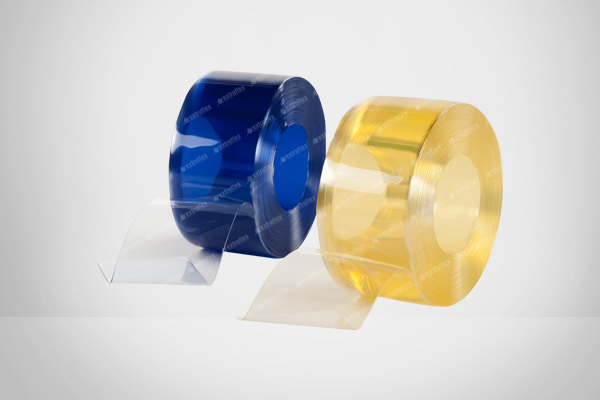
- Standard clear PVC strips are the most widely used option, offering strong visibility along with dust protection and temperature separation. They show up constantly in warehouses, manufacturing floors, retail stockrooms, and distribution centers.
- Polar grade curtains are formulated to stay flexible in low temperatures, where standard vinyl would otherwise stiffen and crack. These are the go-to choices for cold storage rooms, refrigerated warehouses, food processing units, and freezer facilities.
- Anti-insect curtains, usually tinted yellow or orange, are designed to repel flying insects rather than just block them physically. Food production facilities, commercial kitchens, restaurants, and pharmaceutical units rely on these heavily, since a hygiene inspection can flag pest vulnerability even when everything else checks out.
- Welding grade curtains are built to shield nearby workers from sparks, UV radiation, and welding flash, making them standard equipment in fabrication shops, engineering workshops, and metal processing facilities.
- Ribbed PVC strips reduce friction and hold up better under constant movement, which makes them a strong fit for forklift routes, loading docks, and other high-traffic industrial entryways.
- Coloured and opaque curtains are used when visual privacy matters more than visibility, often appearing in production zones, packaging areas, and other sensitive workspaces.
A capable PVC Curtain Manufacturer will walk you through each of these and point you toward the right one based on your facility, not just the one with the best margin.
Understanding PVC Curtain Grades
Type tells you what the curtain is shaped to do. Grade tells you what it is made of, and that matters just as much for long-term performance.
- Standard industrial grade works well for general commercial and industrial use, offering solid durability, good transparency, and a reasonable price point.
- Food-grade PVC is manufactured specifically to meet hygiene requirements in food handling environments, with easy-to-clean surfaces and material composition that supports regulatory compliance.
- Pharmaceutical grade PVC is used wherever contamination control is non-negotiable, which makes it common in laboratories, healthcare facilities, and pharmaceutical manufacturing units.
- Low-temperature grade is engineered to maintain flexibility and structural performance under freezing conditions, rather than going stiff and brittle the way standard vinyl does.
The Real Benefits of an Industrial PVC Strip Curtain
Most businesses install their first strip curtain to solve one specific problem, usually temperature loss. The benefits, though, extend well past that initial reason.
Hygiene improves noticeably as dust, insects, and airborne contaminants get filtered out at the threshold, which matters enormously for food and healthcare operations where this is not optional. Energy efficiency improves, too, since conditioned air stays where it is supposed to stay, easing the load on HVAC systems and lowering operating costs over time.
Workplace comfort goes up as employees deal with fewer drafts and more stable conditions around doorways. Productivity follows, since forklifts and staff move through openings without stopping to manually open or close a door. Noise transfer between zones drops as well, which helps in facilities running multiple operations close together.
There is also a sustainability angle worth mentioning. Less energy wasted on temperature loss means a smaller environmental footprint, which increasingly factors into how facilities are evaluated and audited.
Who Actually Needs These Curtains
The versatility of strip curtains is part of why they show up in such a wide range of settings.
Warehouses and logistics centers use them at loading docks, as internal partitions, and around temperature-controlled zones. Food processing facilities lean on them for hygiene control, insect prevention, and audit compliance. Pharmaceutical units depend on them to maintain controlled environments and manage contamination risk. Hospitals and healthcare facilities use them to separate clean areas and improve general environmental control. Manufacturing plants apply them for dust containment and smoother workflow. Even retail and commercial spaces use them for backroom separation and cold storage access.
Across every one of these industries, the underlying goal stays the same: a cleaner, safer, more efficient environment without sacrificing the flow of people and equipment.
Choosing the Right PVC Curtain Manufacturer
If you are currently comparing suppliers, a handful of questions will quickly separate the reliable ones from the rest.
Ask whether they offer multiple grades. A genuine PVC Curtain Manufacturer should be able to provide industrial, food-grade, polar-grade, and speciality options rather than pushing a single generic product. Ask about dimensional customisation, since no two doorways are identical, and a properly fitted curtain depends on getting those measurements right. Ask what hardware and mounting systems come with the curtain, since a quality rail or bracket system extends durability and simplifies future maintenance.
Ask whether they actually understand your industry. A pharmaceutical cleanroom and a warehouse loading dock have almost nothing in common in terms of requirements, and a supplier who treats them the same probably has not thought it through. And ask about their focus on long-term performance rather than upfront price, since the cheapest option on the invoice is rarely the cheapest option once replacement costs and downtime are factored in.
Mistakes Worth Avoiding
A few recurring missteps tend to undermine an otherwise good curtain installation. Choosing the wrong strip thickness for the traffic volume is a common one, as is ignoring how often the doorway actually gets used. Overlooking temperature requirements leads to curtains that crack within months in cold environments. Prioritizing price over material quality almost always backfires within a year or two. And working with an inexperienced or unproven supplier compounds every other mistake on this list.
A well-chosen curtain, installed correctly, can perform reliably for years. A poorly chosen one quietly turns into a recurring maintenance line item.
The Doorway Upgrade That Pays for Itself
A strip curtain rarely gets noticed when it is working. There is no announcement, no maintenance request, no complaint. It simply hangs there, separating one environment from another, protecting hygiene standards, energy efficiency, and workplace comfort one pass-through at a time.
Whether you are running a warehouse, a food processing plant, a cold storage facility, or any operation where doorways matter more than people realize, the right Industrial PVC Strip Curtain starts with picking a manufacturer who understands the specifics of your environment rather than treating every doorway the same.
If an upgrade is on your radar, FlintronTech offers a full range of industrial-grade PVC strip curtain solutions built for exactly this kind of long-term, low-drama performance. Visit FlintronTech and let their team help you match the right type, grade, and configuration to your facility, so the next thing you notice about your doorways is how little you have to think about them.
