
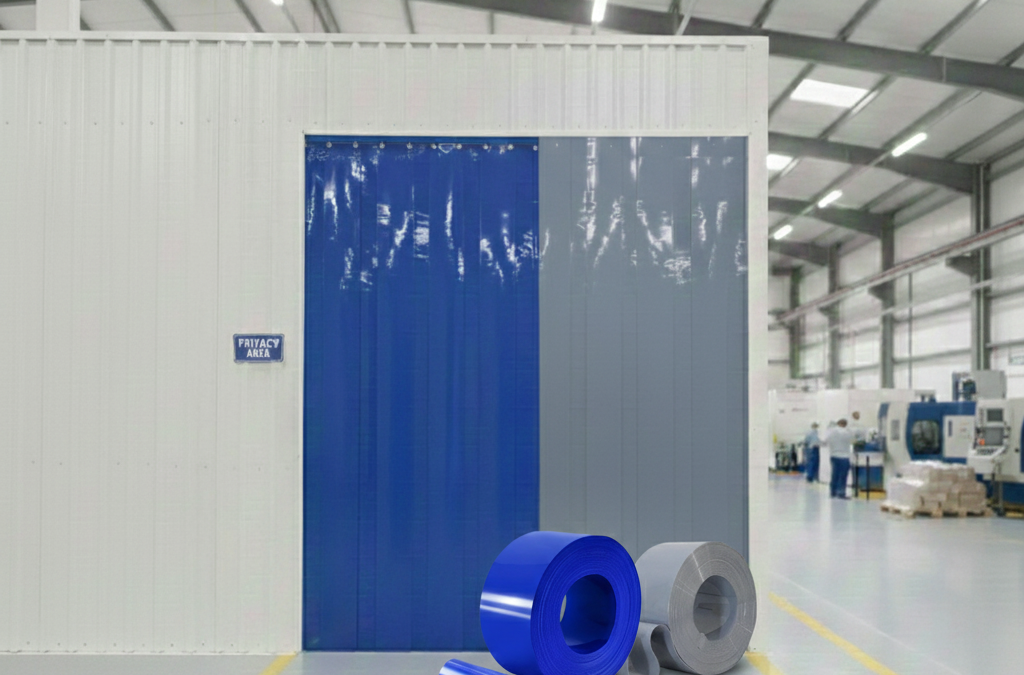
An industrial PVC strip curtain is a flexible door/opening barrier made of overlapping PVC strips that controls temperature, dust, insects, and noise while allowing free movement of people and forklifts, chosen by strip type (standard, low-temperature, welding, anti-static) based on the application.
Every open doorway in a warehouse, cold room, or factory is a gap where cold air, dust, insects, and noise slip through. An industrial PVC strip curtain closes that gap without blocking the movement of people, pallets, or forklifts. This guide breaks down the main strip curtain types, their real-world uses, and how to pick the right one with manufacturing insight from Flintron Tech, which supplies PVC strip curtains under its Fedon range to industrial and commercial facilities across India.
What Is an Industrial PVC Strip Curtain?
An industrial PVC strip curtain is a set of overlapping, flexible polyvinyl chloride (PVC) strips hung in a track across a doorway or opening, acting as a semi-permanent barrier that separates two environments while staying passable for foot and vehicle traffic.
Unlike a solid door, strip curtains don’t need to be manually opened and closed for every pass-through. A forklift or trolley simply pushes through the strips, which swing back into place afterwards. This makes them a practical fit for high-traffic industrial openings where a rigid door would slow operations or where full-time closure isn’t realistic.
Key components of a strip curtain system:
- PVC strips: the flexible panels, usually 150–300mm wide and 2–3mm thick, varying by supplier
- Overlap: strips are hung with a partial overlap between adjacent panels to reduce gaps
- Mounting track or header rail: holds the strips at the top of the opening
- Hardware: brackets, hooks, or a mounting bar fixed to the doorframe or wall
How Do PVC Strip Curtains Work?
PVC strip curtains work by using overlapping strips that flex apart under pressure from a person, cart, or vehicle and fall back into a sealed position by gravity once the opening is clear, maintaining a continuous barrier with minimal energy loss.
The overlap between strips is what determines how effective the barrier is. A higher overlap percentage reduces air and pest infiltration but can add slightly more resistance when pushing through. Facilities balance this trade-off based on how the opening is used; a cold storage dock handling constant pallet movement may prioritize easier pass-through, while a pharma cleanroom entry may prioritize a tighter seal.
Types of PVC Strip Curtains
The main industrial PVC strip curtain types are standard/general-purpose, low-temperature (cold storage), welding/anti-flash, anti-static, and ribbed or grip strips, each formulated or shaped for a specific environmental or safety need.
| Strip Curtain Type | Key Property | Common Application |
| Standard/General Purpose | Clear, flexible PVC, works at ambient temperature | Warehouses, factory floors, retail stockrooms |
| Low-Temperature (Cold Storage) | Remains flexible in sub-zero conditions; won’t crack | Cold rooms, freezers, refrigerated logistics |
| Welding/Anti-Flash | Tinted (amber/bronze/green) PVC that blocks UV flash | Welding bays, fabrication units |
| Anti-Static | Conductive strip formulation to dissipate static charge | Electronics assembly, explosive-risk areas |
| Ribbed/Grip Strips | Textured surface for better hand grip | Manual pass-through doorways, staff entries |
Common Industrial Uses of PVC Strip Curtains
PVC strip curtains are used across cold storage, food processing, warehousing, manufacturing, hospitality back-of-house, and retail to control temperature loss, dust, insects, and noise at high-traffic openings.
- Cold storage & refrigerated logistics reduce cold air loss at freezer and chiller doorways, cutting compressor load
- Food processing plants act as a physical barrier against dust, flying insects, and airborne contaminants between production zones
- Warehousing & distribution centers separate loading dock areas from climate-controlled or dust-sensitive storage zones
- Manufacturing units control noise, dust, and temperature between shop floor zones, including welding bays with tinted strips
- Hospitality & commercial kitchens use kitchen entries and storerooms to keep pests and dust out of food-handling areas
- Retail & mall back-of-house separate customer areas from stockrooms and delivery entries
Which PVC Strip Curtain Type Is Right for Your Facility?
Choosing the right strip curtain comes down to three questions: what temperature range does the opening operate in, how frequently and by what (foot traffic vs. forklifts) is it used, and what contaminant or hazard needs to be kept out. A cold storage dock needs low-temperature strips with adequate overlap; a welding bay needs tinted anti-flash strips regardless of temperature; a food production doorway typically needs standard or ribbed strips sized to the opening width and traffic type.
As a manufacturer, Flintron Tech assesses these factors opening size, traffic type, and environment before recommending a strip configuration under its Fedon range, rather than offering a one-size-fits-all curtain.
PVC Strip Curtains and Food Safety Compliance in India
In India, food processing and food service facilities are expected to prevent pest and contaminant entry at doorways as part of FSSAI hygiene requirements and HACCP-based pest control programs, and PVC strip curtains are a common physical control used to support this.
FSSAI’s food safety and hygiene norms require food businesses to maintain premises that prevent contamination, which extends to controlling entry points where pests, dust, or temperature-sensitive air exchange could compromise product safety. HACCP-based plans typically list door and opening management as a control point in pest management programs. A strip curtain doesn’t replace pest control measures like fly traps or bait stations; it works alongside them as a physical barrier at the doorway itself.
Installation & Maintenance Basics
PVC strip curtains are mounted using a header rail or bracket fixed above the doorway, sized slightly wider and taller than the opening, and require periodic wiping and strip replacement as panels wear, yellow, or crack.
- Measure the opening width and height before ordering; the curtain should extend a bit beyond the frame on both sides
- Choose strip width and overlap based on traffic type: narrower strips for tighter openings, wider overlap for sealing-critical areas
- Wipe down strips periodically, especially in food-handling or dusty environments, to keep them clean and transparent
- Replace individual strips as they crack, yellow, or lose flexibility, rather than the entire curtain, where the track design allows it
FAQs
Q1: What is the difference between standard and low-temperature PVC strip curtains?
Standard PVC strips are formulated for ambient conditions and can become stiff or crack in freezing temperatures. Low-temperature strips use a different PVC formulation that stays flexible in cold storage and freezer environments, which is why they’re specified separately for refrigerated applications.
Q2: Do PVC strip curtains actually help with pest control?
Yes, strip curtains act as a physical barrier that reduces the entry of flying insects and pests through open doorways. They work best combined with dedicated pest control equipment like fly traps, not as a standalone pest solution.
Q3: How much do PVC strip curtains overlap?
Overlap varies by application and supplier specification; higher overlap improves sealing but adds resistance when pushing through.
Q4: Can PVC strip curtains be used in food processing plants in India?
Yes, they’re commonly installed at food processing doorways to support FSSAI hygiene requirements by limiting dust, insect, and contaminant entry, typically as part of a broader HACCP-based pest and hygiene control plan.
Q5: How long do PVC strip curtains last before needing replacement?
Lifespan depends on traffic volume, temperature exposure, and sunlight/UV exposure, since PVC can yellow and stiffen over time. Individual strips are usually replaced as they degrade rather than replacing the full curtain.
Q6: Are welding curtains and strip curtains the same thing?
Not exactly. Welding curtains are tinted PVC strips designed to block UV flash and light from welding, while general strip curtains are typically clear and used mainly for temperature, dust, and pest control rather than radiation shielding.
Q7: Can PVC strip curtains be custom-sized for non-standard doorways?
Yes, most manufacturers, including Flintron Tech, can size strip curtains to specific opening dimensions rather than only offering fixed standard sizes.
Need PVC strip curtains for your facility?
Flintron Tech manufactures industrial PVC strip curtains under the Fedon range, sized and specified for cold storage, food processing, warehousing, and manufacturing environments across India. [https://flintrontech.com/] or [8929100654] for a curtain configuration suited to your doorway and industry. Dealership and bulk/OEM enquiries welcome.
