
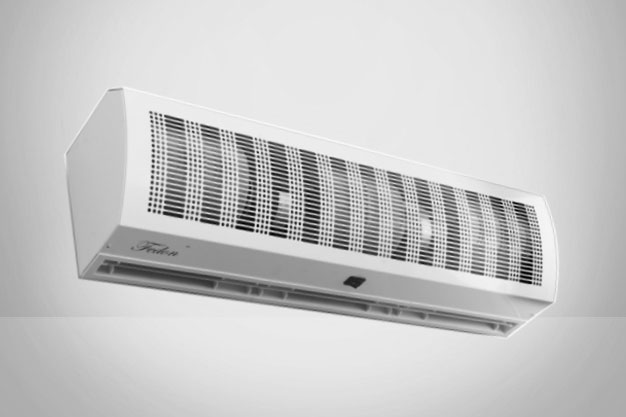
Air curtains are used in public spaces because a fast stream of air across an open doorway keeps out dust, flies and small insects and helps maintain indoor temperature, without needing a closed door.
Walk into a busy mall, hotel lobby or restaurant, and you may feel air blowing down above the door. That is an air curtain at work. As an air curtain manufacturer based in Bangalore, Flintron Tech sees buyers choose them for one reason: they protect hygiene and cooling while doorways stay open. This guide explains how they work, where they fit, and how to choose one.
What Is an Air Curtain and How Does It Work?
An air curtain is an appliance mounted above a doorway that blows a fast, controlled sheet of air across the opening. This invisible barrier slows the movement of dust, flying insects and air between two spaces, so people can walk through freely.
Inside the unit, blowers push air through a narrow outlet along the full width of the door. The airstream hits the floor and forms a barrier that is hard for small insects and dust to cross.
Two points help buyers set expectations:
- An air curtain is a barrier, not a sealed door. It reduces air exchange rather than stopping it completely.
- It works best when the unit is matched to the door’s width and height.
Why Are Air Curtains Used in Public Spaces?
Public spaces use air curtains because they solve three problems at once: pests and dust coming in, cooled air leaking out, and doors that must stay open for customer flow. They do this without a physical barrier that slows people down.
1. Pest and dust control at the entrance
Flies and small insects enter through open doors. The airstream makes crossing the doorway difficult for them. In Flintron Tech’s product literature, Fedon air curtains are designed to prevent dust, flies and other small insects from entering air-conditioned areas.
2. Better temperature retention
When a door is open, cooled air escapes and hot, humid air enters. An air curtain reduces this exchange. The savings depend on door size, footfall and the temperature difference.
3. Hygiene support
Cleaner entrances mean fewer contaminants near food, patients or products. This matters in restaurants, hospitals and food plants.
4. Smooth customer movement
Shoppers and guests pass through without touching or pushing a door. This is useful at high-traffic malls, hotels and quick-service restaurants.
5. Lower running cost with sensors
Sensor models run only when the door opens. According to Flintron’s brochure, this saves power and increases the appliance’s life.
Honest limitation: Strong crosswinds or large pressure differences can weaken any air curtain’s performance. Pair it with other controls where pest risk is high.
Where Are Commercial Air Curtains Used?
A commercial air curtain is used at the entrances of restaurants, hotels, malls, hospitals and shops, where staff and customers move in and out all day and indoor air quality matters.
| Space | Main reason for an air curtain |
| Restaurants and QSR outlets | Keeps flies and dust out of dining and service areas |
| Commercial kitchens | Protects food prep zones from insects and outside dust |
| Hotels and lobbies | Holds cooling at busy entrances |
| Malls and retail stores | Keeps doors open for footfall while retaining air-conditioning |
| Hospitals and clinics | Supports a cleaner entrance environment |
| Food plants and warehouses | Protects goods at loading areas |
Flintron Tech’s customers include Tata, Bosch, Hilton, Sheraton, Apollo, Cafe Coffee Day, LuLu Mall, Chaipoint and Nandini.
Industrial Air Curtain vs Commercial Air Curtain: What Is the Difference?
The difference is mainly scale and duty. An industrial air curtain is built for wide, tall openings such as loading bays and plants. A commercial air curtain suits shops, restaurants and hotels, where noise, looks, and door size are the priorities.
| Factor | Commercial air curtain | Industrial air curtain |
| Typical door | Standard to wide shop or hotel entrance | Wide, tall bay or dock door |
| Priority | Quiet running, neat look | Strong airflow, durability |
| Common sites | Restaurants, malls, hotels | Warehouses, food plants |
| Key spec to check | Noise level, width | Air volume, mounting height |
Flintron Tech’s current Fedon range covers 3 ft to 6 ft widths with metal bodies.
Which Fedon Air Curtain Suits Your Entrance?
Choose the Fedon model whose width matches your door. Fedon air curtains come in four sizes, from about 3 ft to 6 ft, and each is available with or without a sensor.
| Model | Approx. width | Power | Air volume | Mounting height | Weight |
| FM5509L | 3 ft (900 mm) | 450 W | 1,520 m³/h | 12–15 ft | 17.5 kg |
| FM5512L | 4 ft (1,200 mm) | 600 W | 2,027 m³/h | 12–15 ft | 21.5 kg |
| FM5515L | 5 ft (1,500 mm) | 750 W | 2,543 m³/h | 12–15 ft | 27 kg |
| FM55Z18L | 6 ft (1,800 mm) | 800 W | 2,900 m³/h | Up to 12 ft | 24.5 kg |
Common specs across the range: 230 V, 50 Hz, single-phase; wall mounting; air velocity of about 18–21 m/s (18–20 m/s for FM55Z18L); noise below 54–55 dB; powder-coated metal body (aluminium on the 6 ft model).
If your doorway is wider than 6 ft, you can discuss multiple units with Flintron Tech.
How to Choose an Air Curtain Manufacturer in India
A good air curtain manufacturer publishes full specifications, offers several sizes, supports installation and service, and handles both small and bulk orders. Use this checklist before you buy.
- Published specs: air velocity, air volume, motor type, noise level and mounting height.
- Size range: a width that matches your door, not a unit “close enough”.
- Sensor option: useful for power saving at busy doors.
- Build quality: powder-coated metal or aluminium body for durability.
- Service and warranty: ask for terms in writing.
- Order flexibility: bulk, small-batch, OEM and dealership support.
As a manufacturer, Flintron Tech designs and supplies Fedon air curtains alongside its fly traps and strip curtains, so one supplier can cover your pest-proofing entrance needs.
Air Curtains in India: FSSAI, HACCP and Buyer Scenarios
Food businesses in India work under FSSAI hygiene rules, and many follow HACCP (Hazard Analysis and Critical Control Points) to control contamination risks. Open doors in a hot, humid and dusty climate make entrances a common weak point.
Typical Indian buyer scenarios:
- Restaurant and café chains keeping main doors open for footfall in warm cities.
- Food processing units protecting receiving and dispatch areas.
- Malls and hotels retaining air-conditioning at busy entrances.
- Warehouses reducing dust and insects at loading docks.
An air curtain works best as one layer in an Integrated Pest Management (IPM) plan. Pair it with Linnea fly traps inside and PVC strip curtains at loading doors for stronger protection.
Installation and Maintenance Tips
- Match width: the unit should cover the full door width.
- Mount within the rated height: 12–15 ft for most Fedon models, up to 12 ft for the 6 ft model.
- Mount on the inside wall, above the door, with air directed downward.
- Use a sensor model at doors that are opened intermittently.
- Clean regularly: wipe the body and keep intake and blowers free of dust.
FAQs
- What is the main purpose of an air curtain?
An air curtain’s main purpose is to create an invisible barrier of fast-moving air across a doorway. It helps keep dust, flies and small insects out and reduces air exchange between two spaces. This supports hygiene and helps air-conditioned areas hold their temperature while the door stays open. - Do air curtains really keep flies out?
Air curtains help keep flies and small insects out by blowing a strong air stream across the opening, which flying insects find hard to cross. They work best as part of a wider pest control plan, alongside fly traps and good sanitation, rather than as a standalone solution. - Where should a commercial air curtain be installed?
A commercial air curtain is mounted above the door on the inside wall, with air directed downward across the full entrance width. Choose a unit at least as wide as the door and check its mounting height. Fedon models are rated for 12–15 feet, and the 6 ft model is rated up to 12 feet. - What is the difference between an industrial and a commercial air curtain?
The difference is mainly scale and duty. An industrial air curtain is built for wide, tall openings such as loading bays, warehouses and food plants, with stronger airflow. A commercial air curtain suits restaurants, malls and hotels, where quiet operation and looks matter. Always match the model to door size and height. - Are air curtains energy efficient?
Air curtains can reduce the loss of cooled air at open doorways, but savings depend on door size, traffic and temperature difference. Sensor-based models run only when the door opens, which saves power and extends appliance life. Flintron Tech’s Fedon range offers with-sensor and without-sensor variants of every model. - How do I choose an air curtain manufacturer in India?
Look for a manufacturer that publishes full specifications such as air velocity, air volume, motor details and noise level, and offers several sizes plus after-sales service. Ask for warranty terms in writing and check support for bulk, OEM and dealership orders. Flintron Tech manufactures Fedon air curtains in India. - How often does an air curtain need maintenance?
Maintenance is simple: wipe the body, keep the air intake and blowers free of dust, and confirm the sensor responds if one is fitted. Frequency depends on how dusty the entrance is.
Need an air curtain for your restaurant, hotel, mall or plant?
Talk to Flintron Tech, a Made-in-India air curtain manufacturer. Share your door width and height, and our team will recommend the right Fedon model for bulk or single-unit orders.
