
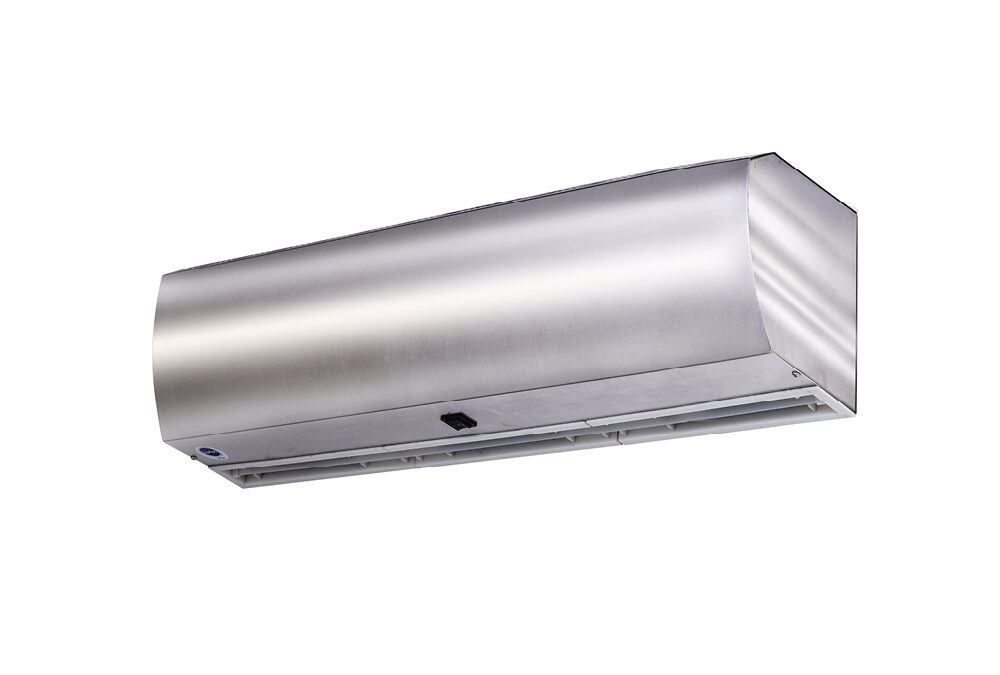
Look, every facility manager has lived this moment: You open the shutter for a routine goods movement… and within seconds, dust swirls in, flies sneak through the gap, and the clean zone you worked so hard to maintain suddenly feels compromised.
It’s frustrating — and honestly, it’s not just a cleanliness issue, it’s a reputation issue. That’s exactly where Industrial Air Curtains make a real difference, creating an invisible barrier that protects indoor environments without slowing down operations.
The real problem isn’t the open doorway. It’s what it invites.
Now, here’s the thing: an industrial doorway isn’t just a passage. It’s a risk zone.
Dust, flying insects, outside heat, fumes, all of it rushes in the moment a door is open.
And if you’re in food, pharma, packaging, healthcare or cold storage, you already know that even a few seconds of exposure can mean:
- contamination risk,
- unhappy inspectors,
- compromised temperature control,
- messy workflows,
- Higher cleaning costs.
It’s not just about keeping pests out. It’s about protecting the entire ecosystem of hygiene, compliance and comfort inside your facility.
Why old-school methods fail (every single time)
Let’s be real: heavy doors, PVC strips, and manual vigilance are not optional, but they’re not enough either.
- Manual closing? People forget.
- PVC strips? They tear, get cloudy, collect grime, and rarely stop small insects.
- Fly sprays? Chemical residue + food areas = not acceptable.
- Mesh doors? Great at home. Useless at loading docks.
These methods scream for attention… but not in a good way. What you need is a quiet guardian, a system that works silently in the background, whether your staff remembers or not.
Enter the Industrial Air Curtain, the quiet warrior at your doorway
If you’re new to it, an air curtain sounds almost too simple: A machine above the door blows controlled, high-velocity air downward.
But that “sheet of air” becomes an invisible barrier against:
- pests,
- dust,
- hot air,
- fumes,
- humidity,
- cross-contamination.
They don’t scream for attention. They just work. Day after day. Shift after shift.
How Industrial Air Curtains actually work (explained simply)
Think of it as a non-stop wind wall, engineered with precision.
Here’s the science, without the jargon:
- A high-speed motor pulls air from the surroundings.
- The system accelerates it using a specialised blower.
- The air is pushed downward in a uniform linear stream across the doorway.
- That stream creates a pressure difference, preventing external contaminants from entering.
It’s not just fast air. It’s structured, controlled, energy-efficient airflow designed for protection.
The 6 Features That Truly Guarantee Pest & Dust Control
If you’re evaluating Industrial Air Curtains, these six features separate average machines from the ones that deliver real hygiene protection.
1) Correct Air Velocity (Not Too High, Not Too Low)
For industrial zones, you typically need 12–20 m/s at the nozzle.
Too low = insects walk right through.
Too high = discomfort and energy loss.
Look for calibrated, tested air velocity and not mere guesswork.
2) Wide, Uniform Airflow Spread
Uneven air means weak spots.
Weak spots mean entry points.
A good air curtain maintains a continuous, gap-free barrier from end to end.
3) Purpose-Built Industrial Motor
Not the kind used in decorative or retail air curtains.
You need:
- higher torque,
- continuous-duty performance,
- thermal protection,
- longevity in dusty environments.
This is where most cheap models fail.
4) Proper Mounting Height Compatibility
Your doorway height determines the performance.
A real industrial air curtain should cover 8–12 ft without losing velocity.
If the machine can’t match your height, it won’t protect your space.
5) Energy-Efficient, Low-Noise Operation
You don’t want a loud machine that becomes a daily nuisance.
A well-designed air curtain remains:
- silent enough for normal conversation,
- efficient enough to run all day without guilt.
A quiet hero in the background.
6) A Build Meant for Harsh Indian Conditions
Heat, dust, humidity, and insects; our environment is tougher than most catalogs admit.
Look for:
- powder-coated or stainless steel body,
- sealed bearings,
- strong mounting brackets,
- easy-clean access.
It’s not just about performance.
It’s about longevity in real-world conditions.
Who needs Industrial Air Curtains the most?
Honestly, any place with temperature, hygiene or pest-control standards should consider one.
But these settings benefit the most:
- Food factories (prevent contamination)
- Pharma units (protect clean zones)
- Cold storage (maintain temperature stability)
- Commercial kitchens (stop flies entering prep areas)
- Warehouses & logistics hubs (dust control)
- Retail stores (comfort + energy efficiency)
- Hospitals & labs (infection control)
Each environment has its own risks, but the story is the same:
An air curtain quietly keeps chaos out.
How to choose the right Industrial Air Curtain (Practical buying guide)
If you’re planning to install one, ask your supplier these questions:
- What is the recommended velocity for my door height?
- Can you provide performance test reports?
- Is the motor truly industrial grade?
- What is the noise level during continuous operation?
- What is the airflow width coverage?
- What maintenance does it require?
- Do you offer custom sizing for wider doors?
And here’s a common mistake: choosing based solely on price.
Cheap units lose velocity in weeks, and once that barrier fades, your protection is gone.
At the end of the day…
An Industrial Air Curtain isn’t just a machine. It’s a silent guardian for hygiene, safety, and comfort.
If you’re thinking about upgrading your facility, or if inspections are becoming too stressful, an air curtain might be one of those things you don’t notice until it’s missing, and then you wonder how you ever worked without it.
You can explore industrial air curtain options and learn more at www.flintrontech.com


